
Yi Yang 1, Dianyou Kang 2 and Anton Louise De Ocampo 1,*
1 Department of Electronics Engineering, Batangas State University, Batangas City 4200, Philippines
2 Department of Information Engineering, Jiangmen Technician College, Jiangmen 529090, China
* Correspondence: antonlouise.deocampo@ieee.org
Received: 7 May 2026 Revised: 27 August 2026 Accepted: 1 September 2026 Published: 14 September 2026
ABSTRACT
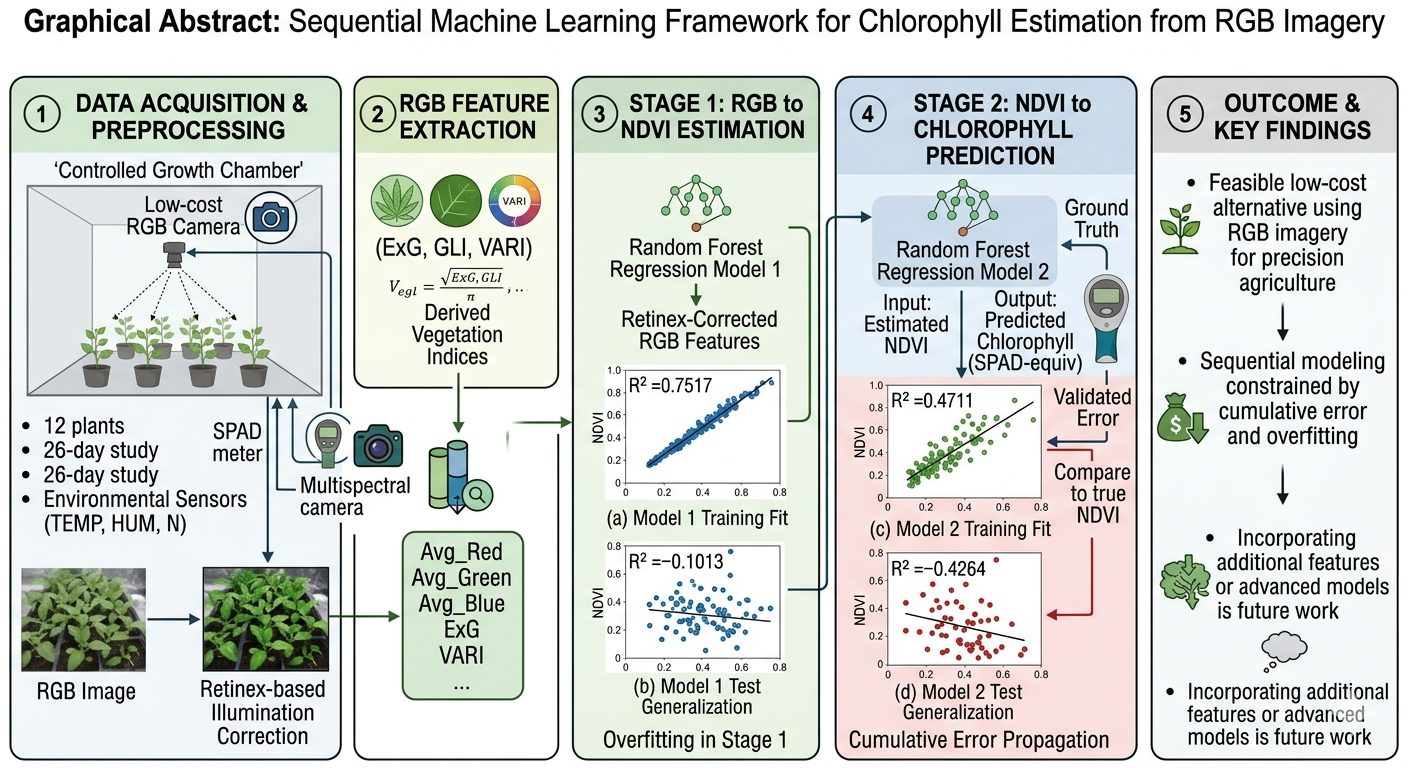
RGB imaging is often proposed as a low-cost alternative to multispectral sensing for estimating vegetation chlorophyll status, but its reliability under realistic, small-sample controlled-environment conditions is not well established. This study presents a preliminary evaluation of a two-stage machine learning pipeline that estimates NDVI from RGB-derived vegetation indices (Stage 1), then uses the estimated NDVI to predict SPAD meter readingsan optical, relative chlorophyll indexas a proxy for leaf chlorophyll status (Stage 2). Data were collected from 12 ‘Olmetie’ lettuce plants over 26 consecutive days (309 valid image/reading pairs) using a MicaSense Altum-PT multispectral camera alongside a Konica Minolta SPAD-502 meter. All models were evaluated under strict Leave-One-Plant-Out cross-validation (LOPO-CV), with Plant ID used exclusively as the grouping variable for fold assignment never as a predictor-and all preprocessing and hyperparameter choices re-derived per fold using only the 11 training plants. Under this scheme, a Random Forest-based Stage 1 (RGB-NDVI) achieves R2 = 0.027, and the full two-stage pipeline (RGB-estimated NDVI-SPAD) achieves R2 = −0.128. Direct RGB-SPAD prediction (R2 = −0.071) and prediction from measured NDVI→SPAD (R2 = −0.076) perform similarly, indicating that the bottleneck is not primarily RGB-to-NDVI estimation error but limited NDVI-SPAD transferability across unseen plants at this sample size. Ridge regression reduces negative R2 values (measured NDVI→SPAD: R2 = +0.004; RGB-SPAD: R2 = −0.007), consistent with less overfitting at n = 12 biological replicates. A mixed-effects model shows a significant fixed effect of NDVI on SPAD (β = 5.67, p = 0.019), and Spearman rank correlation between LOPO predictions and true SPAD is significant (ρ = 0.119, p = 0.037), indicating modest relative ordering ability despite poor absolute prediction. Due to the small sample size (12 plants), absence of wet-laboratory chlorophyll validation, repeated-measures data structure, and lack of external validation, these results are preliminary and non-generalizable. We do not claim reliable, scalable, or field-ready chlorophyll prediction from RGB imagery on this basis, and identify expanding the number of independent plant replicates as the most direct path toward a more conclusive evaluation.
Keywords: RGB imaging; NDVI estimation; SPAD meter; relative chlorophyll index; two-stage machine learning; leave-one-plant-out cross-validation; controlled environment; preliminary evaluation

This work is licensed under a Creative Commons Attribution 4.0 International License.